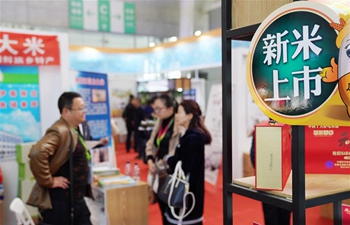
SHIJIAZHUANG, Oct. 10 (Xinhua) -- Over 1,000 exhibitors from more than 50 countries and regions took part in the International Passive House Conference in Baoding, north China's Hebei Province, the first time the event that calls for energy efficiency in building was held outside Europe.
Dr. Wolfgang Feist, professor from the University of Innsbruck and chair of the conference's organizing committee, said the conference together with the exhibition are a significant opportunity to "intensify efforts for global improvement of building standards and thus contribute significantly toward climate protection."
"Passive house," originating from the German term "passivhaus," refers to a standard for energy efficiency in a building through a design process integrated with architecture.
Gaobeidian, about 100 km south of Beijing, hosts the three-day conference in a district that boasts a passive building construction area of 1.2 million square meters, representing the world's largest passive complex. It provides an 80,000-square meter space for this year's event under the theme "Passive House Worldwide."
Ni Haiqiong, president of Orient Sundar Group, China's largest supplier of energy-saving windows and doors, said when attending the conference that the company headquartered in Gaobeidian is committed to the research and development of energy-saving materials, due to the construction industry's importance for energy conservation and emission reduction.
He said among the total social energy consumption, industrial energy consumption accounts for 36 percent, traffic energy consumption accounts for just 24 percent while building energy consumption takes up 40 percent.
Feist said in his keynote speech to the conference that opened on Wednesday that using a heat exchange system, shading system and fresh air system, a passive room can save 95 percent of energy consumption while maintaining a constant indoor temperature and humidity, which is beneficial in dealing with global climate change.
The Chinese government set a guideline in 2017 proposing demonstration projects of ultra-low-energy-consuming and near-zero-energy-consuming buildings.
Hebei is taking the lead in the response to the call. By September 2019, the province had built 67 ultra-low-energy buildings with a construction area of 3.17 million square meters.
Zhang Gujiang, vice governor of Hebei, said at the conference that Hebei issued a design standard for passive building in 2018, which was the first time the standard was incorporated into local laws and regulations in China.
Several other Chinese provinces and municipalities including Shandong, Henan and Beijing have also built demonstration passive house projects and issued preferential policies such as offering financial subsidies, incentives, green credits and tax and fee relief to support passive house building.
Wang Zhen, a resident in Gaobeidian's passive house district, said the temperature in her house remains at 20 degrees Celsius without heating in winter or air conditioning in summer.