ADDIS ABABA, Sept. 14 (Xinhua) -- As this year's Ethiopian New Year celebrations coincided with the 2019 Chinese Mid-Autumn Festival, Chinese expats residing in Ethiopia have joined their Ethiopian counterparts to mark the two unique events with colorful cultural activities.
The East African country on Thursday marked its unique New Year, or Enkutatash in the Amharic language, which falls on September 11 (or September 12 during a leap year), as per the country's unique calendar that counts its year seven to eight years behind the Gregorian calendar. Presently, the country is celebrating the arrival of 2012.
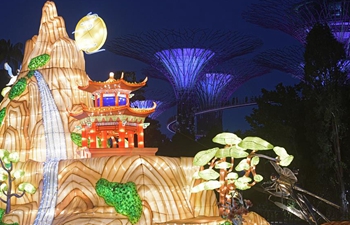
The week-long celebrations of Ethiopia's New Year has coincided with the traditional Chinese Mid-Autumn Festival, which fell on Sept. 13 this year. The festival is an important tradition among Chinese people, which features family reunions, watching the full moon while eating mooncakes together.
The double festivals have provided a moment for both Ethiopians and Chinese expats to celebrate the two events under a single roof, enjoying the two countries' rich cultural and historical values.
On Saturday, Ethiopian and Chinese staff from the Chinese construction giant, China Civil Engineering Construction Company (CCECC) Ethiopia branch, gathered in the Ethiopian capital Addis Ababa to mark the two events with various activities.
The colorful event, among other activities, featured coffee ceremony, which is an integral part of the Ethiopian New Year celebrations.
The Ethiopian coffee serving and drinking ritual, which can last for hours, is an important social occasion offering reunion for relatives and friends and a chance to discuss community matters while enjoying top-notch coffee. Invitation to a coffee ceremony in an Ethiopian family is a sign of great respect.
Attending the joint celebrations, both Chinese and Ethiopian colleagues also enjoyed the festive ambiance by exchanging gifts and learning each other's language.
Chinese expats, who have joined their Ethiopian counterparts to mark the joint cultural events, also expressed their distinctive sentiment.
Kang Rongyao, a young Chinese university graduate who just relocated to the East African country some three weeks ago after joining the CCECC Ethiopia branch, describes the event as "a unique experience," eventually helping him to get settled in life outside his home country.
"Celebrating the two unique events in one place together with my Ethiopian colleagues, I was astounded and delighted with the diverse traditions and cultural values of our two countries," Kang told Xinhua on Saturday.
"The emphasis on family bond and well-preserved traditions of the celebration gives me a glimpse of the profound Ethiopian culture, which I think is in many ways similar to the Chinese," Kang added.
"We celebrated our New Year and the Chinese Mid-Autumn cultural festival together. The ceremony was unique as both events are related to each other," Selam Simegn, Assistant to the Manger at the CCECC Ethiopia branch, told Xinhua on Saturday.
"The Chinese Mid-Autumn Festival manifests the coming of new harvest season as the full moon glows," said Simegn, an Ethiopian, who added that she is happy to taste the mooncakes baked by her Chinese colleagues.
Meanwhyile, Enkutatash, the Ethiopian New Year, marks the end of the three-month rainy season, when bright autumn days return to the vastly highland nation. On the eve, each household or neighbors in group light wooden torches called "Chibo" to symbolize the coming of the new season of sunshine.
Steeped in the Ethiopian Orthodox Church traditions, Enkutatash celebrations usually begin with church activities. New Year church programs start some time after mid-night on the eve and last into the next morning.
The New Year brings an extended family together to attend a series of events, including slaughtering of cattle, either a sheep, goat or cow, depending on a household's financial condition. Often, a community or a village will pool money to slaughter a cow, while each household can choose to slaughter a less expensive sheep.