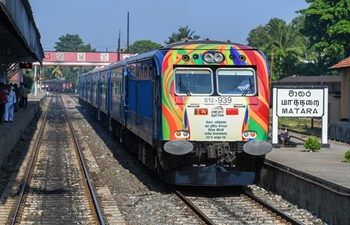
URUMQI, April 9 (Xinhua) -- The freight train service linking Chinese cities with Europe are breathing new life into the ancient Silk Road with its rapidly expanding network.
In May 2011, a rail route was opened between Chongqing and Duisburg in Germany, marking the start of the China-Europe cargo train service.
Boosted by the Belt and Road construction, the international train service has been expanding fast over the past eight years.
A total of 48 Chinese cities have launched 65 freight train routes, reaching 14 countries and more than 40 cities in Europe in 2018. Over 13,000 trips have been conducted by the China-Europe trains as of March.
Nan Jun, deputy general manager of the Xinjiang Xintie International Logistics Company, operator of Urumqi China-Europe train logistics center, has been a witness to the development of the train service, as 70 percent of the China-Europe trains exit or enter China through Xinjiang.
According to Nan, when the logistics center was opened in May 2016, only four international lines were available, with trains operating once per week. Now there are 21 international lines, with at least three trains operating daily.
International trains starting from Urumqi can reach destinations in Kazakstan in 48 hours, Uzbekistan and Tajikistan in 72 hours, Russia in eight days, the Netherlands in 16 days and Italy in 19 days.
Cargoes traveling on the China-Europe rail routes have also been expanding in categories, from electronics and grocery products initially to some 200 categories including mechanics, chemical products, textiles and foods.
Local products in Xinjiang have also caught these trains heading for Europe. For example, locally produced tomato ketchup has arrived at the dinner tables of Italians, thanks to the train service.
The Alataw Pass and Horgos of Xinjiang are the two ports through which the trains enter or exit China.
Wang Chuanjie, head of the Alataw Pass Customs, said the port now sees an average of seven international trains passing through it every day, compared to only one every month several years ago.
Staff at the two ports have been working to improve customs clearance efficiency for the trains, from 24 hours previously to less than 14 hours.
Ning Jizhe, deputy director of the National Development and Reform Commission, said earlier this year that more places would be connected by the China-Europe trains.
China will continue promoting the commercialization of the trains and upgrade the trains with digital technologies, he said.