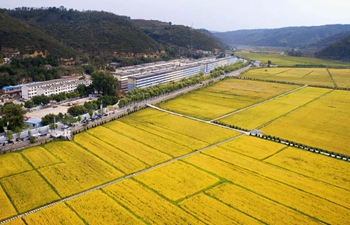
YINCHUAN, Sept. 16 (Xinhua) -- The distance between the southern edge of the Tengger Desert and the city of Zhongwei in northwest China's Ningxia Hui Autonomous Region was once just a few kilometers, but the distance has been expanding over the past several years.
Tengger, the fourth largest desert in China, is mostly in the Inner Mongolia Autonomous Region and stretches to parts of Ningxia and Gansu Province.
Residents of Zhongwei, which neighbors Inner Mongolia and Gansu, have suffered from desertification and land degradation for decades.
They said that in the 1950s, the distance between the desert and the city was around 5 kilometers. A breeze would bring dust and sand from the desert into their homes.
The situation has now been improved significantly. Desertification is under control and the desert no longer moves towards the city. The distance between the desert and Zhongwei has expanded to more than 20 kilometers.
A World Bank desertification control project has played an important role in leading to these huge changes.
The Changliushui Project started in 2013, with a World Bank loan of 300 million yuan (44 million U.S. dollars) to address desertification and land degradation.
"First we established straw checkerboards to halt the movement of shifting sand dunes. Then we sowed grass seeds and planted shrubs. Eventually, we turned the desert into an oasis," said Tang Ximing, who is in charge of the project.
Lin Xiuxia, 45, a resident of Heilin Village, has been making straw checkerboards for more than three years.
"Making straw checkerboards is a laborious and difficult task. Women usually wrap scarves around their faces and heads tightly to avoid sunshine and sand, while men wear straw hats," Lin said.
From March to October, Lin and other residents work around 12 hours per day in the desert. "Sometimes, we need to eat five meals a day, because it requires so much physical effort."
But Lin and her colleagues' hard work has been repaid with a good income and a better living environment.
In the village, over 200 residents make straw checkerboards. They work not only in Zhongwei but also in Inner Mongolia, Xinjiang Uygur Autonomous Region, and Shaanxi Province. The average income is around 70,000 yuan per person annually.
"It's not only a desertification control project. It has become a poverty alleviation project as well," said Tang, adding that the Changliushui Project has paid local residents more than 70 million yuan over the past six years.
As the project continues, straw checkerboards placed in the project area years ago are now covered by thriving sandy soil plants.
"I was born and grew up in the city. Desertification control is vital to sustain the city's development. We have received assistance from the international society, therefore, we should work harder by ourselves," Tang added.
The 52-year-old invented a seeding machine, which could plant seeds in the desert achieving a higher survival rate and lower labor cost.
The "straw-checkerboard mode" has prevented the desert from engulfing the city and the city's environment has become much better.
The project aims to bring 23,000 hectares of the desert under control when it ends in 2019. So far, more than 20,000 hectares have been harnessed.
The Changliushui project is part of the World Bank's desertification control and ecological protection project in Ningxia, one of the most ecologically fragile areas in northwestern China. The region has been struggling with droughts, wind and sand, water and soil loss, and soil salinization.
Statistics showed that the desertified land in the region reached nearly 3 million hectares in 2012, accounting for 57.2 percent of the total area of the region.
The World Bank approved a loan of 80 million U.S. dollars to help control desertification and land degradation in Ningxia. Since 2013, projects covering an area of over 55,000 hectares have been started in Zhongwei, Lingwu, Qingtongxia and Wuzhong cities, as well as Yanchi County.
"Ecologically fragile areas in northwest China are always economically less-developed areas. Introducing international aid programs can obtain supplementary financing for indigenous ecological improvement projects," said Li Zhigang, director of the Ningxia management center for international forestry cooperation projects.
"The significance of the World Bank's project goes beyond ecological benefits. It has also increased local residents' incomes and accelerated social development," Li added.